Bulgarian Split Squats: Setup Checks and Five Mobility Exercises
Bench height, stance and balance can limit split squat depth. Five drills target the hip, ankle and control demands behind a steadier bottom position.
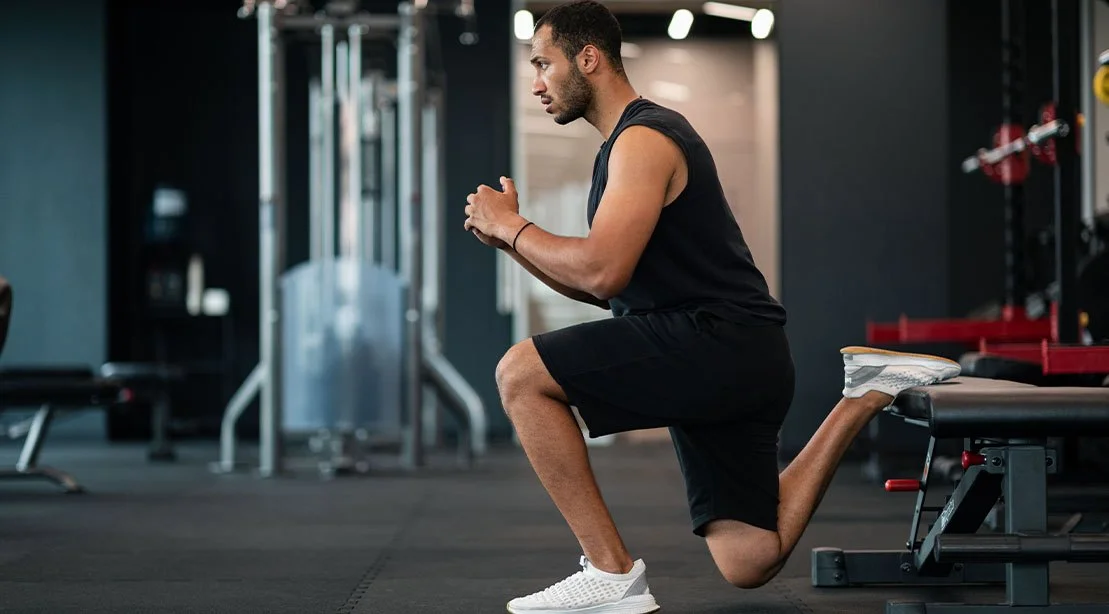
The Bulgarian split squat asks for more than strong legs. Getting into a controlled bottom position also depends on rear hip extension, front ankle movement, balance and the ability to keep the pelvis and trunk steady. When one of these pieces is limited, adjusting the setup may help more than adding another mobility drill.
The exercise can build quadriceps and glute strength and size, and may help address strength differences between sides. But a deeper position isn’t automatically better: the useful target is a range you can reach and control without losing balance or compensating through your lower back.
Check the movement before choosing a drill
Set your rear foot on a bench and choose a stance that feels stable. Keep the front foot planted, brace your trunk, lower as far as you can, and hold the bottom for five seconds. Stand by pushing through the front foot, then repeat on the other side. The hold can reveal whether you can reach and maintain the position, as well as whether one side feels different.
Notice what changes as you descend. A front heel that lifts may point to limited ankle dorsiflexion or a stance that needs adjusting. A pronounced lower-back arch can accompany limited extension at the rear hip or difficulty controlling the pelvis. If the front knee falls inward, hip stability may be part of the challenge. A strong pull through the back thigh may reflect restricted hip flexors, while wobbling can arise from balance, setup or stability.
These signs are clues, not a diagnosis. The aim is to identify what makes the movement difficult, rather than to force a particular depth or appearance.
Rule out a setup problem
Bench height and foot placement change the demands on the back leg and the space available to descend. A standard weight bench may be too high for some lifters, increasing the stretch across the rear hip and making it harder to keep the lower back steady. A lower box or stacked plates can offer a more manageable starting point; height can be increased as control allows.
Stance length matters, too. Standing too far from the bench asks for more extension at the rear hip, which may encourage the pelvis to tip forward or the lower back to arch. Moving the front foot closer can reduce that stretch. Standing too close can feel cramped, make balance harder and invite more pushing from the back leg. In that case, move the front foot forward a few inches and reassess. Look for a position where the front hip and knee can bend and the front leg does most of the work.
If the main issue is wobbling, mobility may not be the limiting factor. Holding a stable support with one hand can make it easier to practice the position. A two- to three-second pause at the bottom also gives you time to build control and confidence there.
What the bottom position asks of you
The rear hip needs enough extension for the leg behind you. When that range is limited, the body may compensate by arching the lower back, tipping the pelvis forward or cutting the descent short. The rectus femoris, one of the quadriceps muscles, crosses both the hip and knee. It lengthens as the rear hip extends and the knee bends, so restriction can feel like a pull across the front of the thigh.
At the same time, the front hip needs to bend as you lower, and the front ankle needs to let the knee travel forward while the foot stays planted. The inner thigh muscles, or adductors, contribute to hip movement and help control the lower body. Core strength, glute strength and hip stability help keep the trunk and pelvis in position. Range of motion gets you into the position; strength and control help you hold and leave it.
Five drills for mobility and control
1. Lateral lunge to box
This movement takes the hips and adductors through a side-to-side range while asking you to control the working leg. That can complement the front-to-back demands of a split squat, where hip control helps limit unwanted shifting.
- Stand sideways, about one step from a low box or a stack of plates, with your knees slightly bent.
- Step onto the box and hinge back into the working hip. Keep your chest lifted and the opposite leg straight.
- Lower into the working hip as far as you comfortably can, pause briefly, then push through that foot to return.
As a warm-up, the source suggests 10 repetitions per side without added weight. As an accessory exercise for squats or deadlifts, it suggests two to four sets of 8 to 15 repetitions per side.
2. Couch stretch
The couch stretch targets the hip flexors and quadriceps of the rear leg. Because the rectus femoris crosses the hip and knee, limited length there may contribute to a strong front-of-thigh pull or a shortened range in the split squat.
- Put a folded mat or pad near a wall and kneel with your back toward it.
- Place one knee on the pad and that foot against the wall. If the stretch is strong, start with the knee farther away.
- Bring the other foot forward into a half-kneeling position. Squeeze the glute on the kneeling side, keep your abs braced and grow tall.
- Bring your torso upright slowly until you feel a stretch. Hold, then switch sides.
The source suggests two holds of 30 to 60 seconds per side as part of a warm-up. The stretch should remain controlled; the goal is to find a tolerable position, not to force the torso upright.
3. Weighted ankle rocker
Front ankle dorsiflexion lets the knee move forward over the foot during the descent. Practicing that motion with the foot planted may help if the heel lifts or the knee feels restricted.
- Set up half-kneeling, with the front knee above the ankle and the hips aligned over the knees.
- Rest a light kettlebell or dumbbell on the front thigh, just above the knee.
- Keep the foot planted and slowly guide the knee forward over the toes. Use the weight as light assistance, pause near your comfortable end range, then rock back.
- Repeat for repetitions and change sides.
The source suggests two sets of eight repetitions per side during a warm-up.
4. Front-foot elevated split squat with a pause
Elevating the front foot allows practice through a deeper split squat range. The pause adds time to develop strength and control at the bottom, which can help when a lifter can reach the position but tends to bounce out or rely heavily on the back leg.
- Place your front foot on a sturdy platform about two to four inches high and find a comfortable split stance.
- Brace your abs and lower under control, letting the front knee travel over the toes.
- Descend only as far as you can keep the front foot and hips controlled. Pause for two to three seconds without relaxing.
- Push through the front foot to rise, then repeat before switching sides.
The source suggests two sets of six repetitions per side, with a three-second pause, as part of a warm-up.
5. Half-kneeling hip flexor mobilization with overhead reach
This drill targets the hip flexors involved in extending the rear hip, including the iliopsoas. The overhead reach and side bend add a stretch while the glute and trunk work to keep the pelvis steady.
- Kneel on a pad in a half-kneeling position.
- Squeeze the glute on the kneeling side and keep your ribs stacked over your hips.
- Reach the same-side arm overhead and bend away from the kneeling leg. Avoid twisting or arching your lower back.
- Pause briefly, return to the start and repeat before changing sides.
The source suggests two sets of eight reaches per side, holding the stretched position for three seconds.
Pair range with control
Start by checking the bench height, stance and balance. If those changes make the descent more comfortable, they may be enough. If not, the drills offer ways to practice hip and ankle range alongside strength and control. The practical goal is a bottom position you can reach, hold and rise from with the front foot planted and your trunk steady.