Mitochondrial Replacement Therapy for Infertility: What the Evidence Shows
MRT is being marketed to older patients despite limited evidence. A clinic’s unpublished data may help clarify what the treatment can—and can’t—show.

Mitochondrial replacement therapy (MRT) is being offered to some people seeking help with infertility, including women over 40, even though evidence that it improves their chances of pregnancy is limited. An eight-month investigation by STAT reporter Megan Molteni examined the companies connecting patients with clinics abroad, the treatment’s scientific uncertainties and the experiences of women who pursued it.

The reporting centers on a gap between the promise some companies make and what research has established. MRT is intended to help prevent certain mitochondrial disorders. Its use for age-related infertility is a separate question, and the available evidence described in the report does not establish that it raises the likelihood of pregnancy for older women.

What the treatment involves
In MRT, a patient’s genetic material is placed into an egg from a donor. The donor egg supplies mitochondria, structures that help cells produce energy. The intended result is an embryo that carries the patient’s genetic material while receiving mitochondria from the donor. The procedure has been described as a way to help an embryo develop into a healthy pregnancy and baby.
That biological rationale doesn’t by itself show that MRT can address age-related infertility. The treatment’s potential role in preventing inherited mitochondrial disease does not demonstrate that replacing mitochondria can reverse the changes associated with reproductive aging. A clinic offering the procedure and a patient hoping for a genetically related child also don’t substitute for evidence from well-designed studies.
The report follows Heidy Willis, who had struggled to become pregnant after several unsuccessful rounds of IVF. She traveled to Albania for MRT. Her experience is one patient’s story; it cannot establish whether the treatment works or how likely it is to help others.
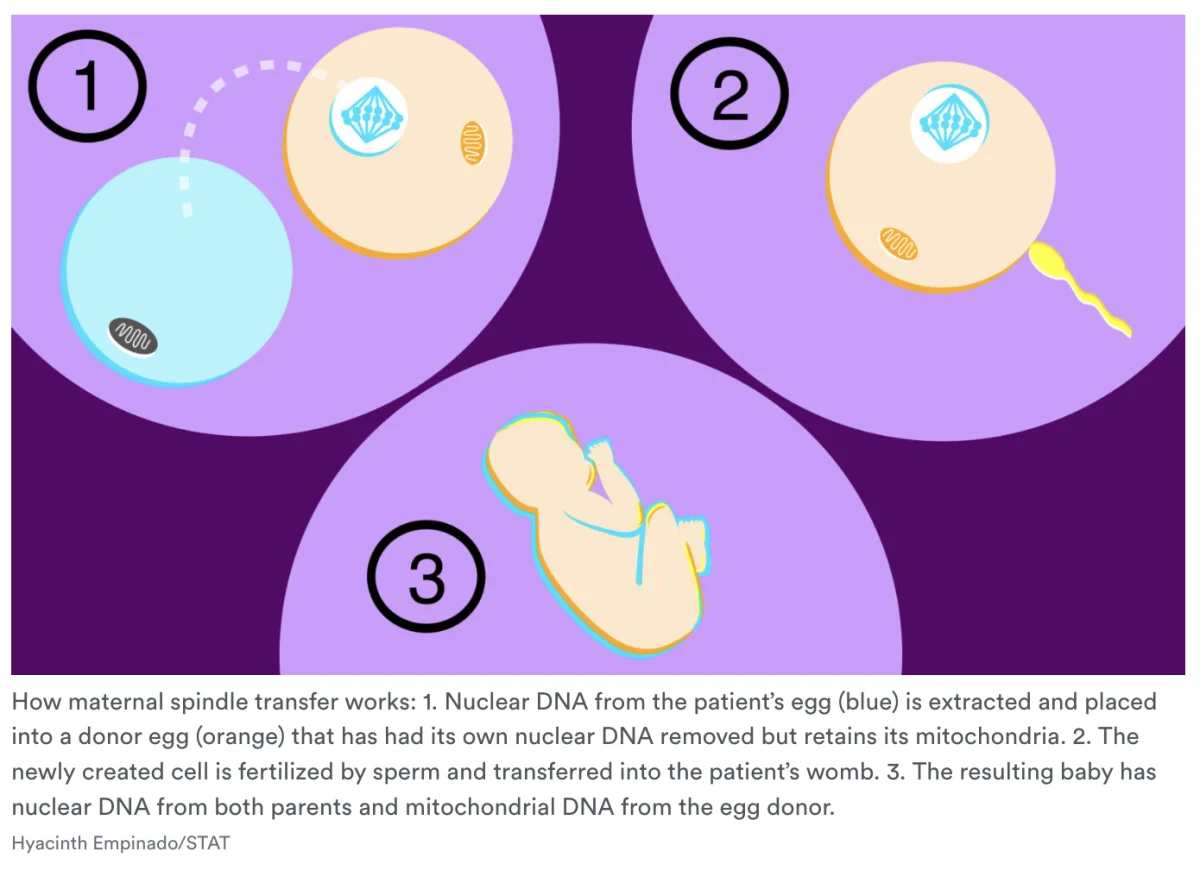
MRT is not available in the United States. Medical tourism businesses charge thousands of dollars to connect patients with clinics in other countries. The investigation found that some of these companies market the procedure to women over 40, a group for whom the evidence of benefit is particularly sparse. One bioethicist at Johns Hopkins University described patients paying for “the privilege of being a guinea pig.”
Why the reporting took months
Molteni had followed MRT for years, including reporting in 2019 on results from a small pilot study and later coverage of developments in the United Kingdom. The investigation began in February, when a couple in the U.K. contacted her about a reproductive tourism company called IFG. The company was presenting MRT as a treatment for age-related infertility, though the evidence supporting that claim was limited.
The woman who contacted Molteni was a doctor in her 40s. She had been drawn by the possibility of having a genetically related child, but chose not to proceed after troubling experiences before treatment. She knew other women who were pursuing MRT and helped the reporter speak with them. Their accounts gave the investigation a view into how the treatment was presented to prospective patients and how the process unfolded for those considering it.
Following the patient journey was difficult because reproductive tourism can involve several companies and clinics in different countries. Each may handle a separate part of the process, making it hard to understand who is responsible for a decision or what happens at each stage. MRT adds scientific and legal complexity. To see the process firsthand, Molteni traveled to a clinic in Albania, where the rules permit technologies such as MRT.
That reporting approach matters for readers assessing claims made across borders. Information about a treatment may be spread among businesses and clinics, while patients have to weigh the claims without the kind of evidence that would clearly establish likely benefits. The investigation’s patient interviews illuminate those experiences; they do not answer the clinical question on their own.
A clinic’s data may challenge the sales pitch
One of the investigation’s most consequential findings was access to long-awaited results from a clinic in Ukraine that had once been among the most active MRT providers. Scientists had been waiting for the data to be published. After the war began in 2022, communication from the clinic’s research team had become quiet.
Molteni contacted Pavlo Mazur, the clinic’s former embryologist, to ask what he thought about commercial clinics offering MRT for age-related infertility. The conversation led to months of discussions and access to data that had not been published. Mazur wanted the findings to be available, though the reasons they had remained unpublished were mixed. Molteni also described biases that can affect how researchers view work from countries without a long record of evidence-based medicine and well-regulated biomedical research.
The clinic’s results, as characterized in the interview, offer a strong challenge to the claim that MRT can serve as a dependable remedy for age-related infertility. That does not settle every question about the treatment. The source does not provide the study’s sample size, detailed outcomes or design, so readers cannot assess those features from this account alone. Nor does the data establish how MRT compares with other fertility care for a particular patient.
What patients can take from the findings
The central distinction is between a treatment’s proposed mechanism and proof that it improves a health outcome. MRT has a biological rationale, but claims about pregnancy chances need evidence from patient outcomes. For age-related infertility, the investigation describes that evidence as scant, while reporting that clinics and intermediaries are already offering the procedure to hopeful patients.
Anyone considering fertility care abroad may find it useful to ask a fertility specialist or another trusted clinician what evidence supports a proposed treatment for their circumstances, what outcomes have been measured, and what remains uncertain. A pharmacist may also be a useful source for questions about medicines used as part of care. The investigation’s strongest practical message is to weigh a promise against the evidence available for the specific reason a treatment is being offered.
Molteni’s reporting brings patient experiences and previously unavailable clinic data into a debate that has often been difficult to follow across borders. The next important question is whether the underlying results become available in enough detail for independent assessment. Until then, MRT’s use for age-related infertility remains an uncertain prospect, not an established way to improve the odds of pregnancy.