Texas Hospital Financial Aid: Why Screening Before Billing Matters
A Texas review found that many nonprofit hospitals delay financial aid screening, while patients may miss help, keep paying bills, or receive no refund.
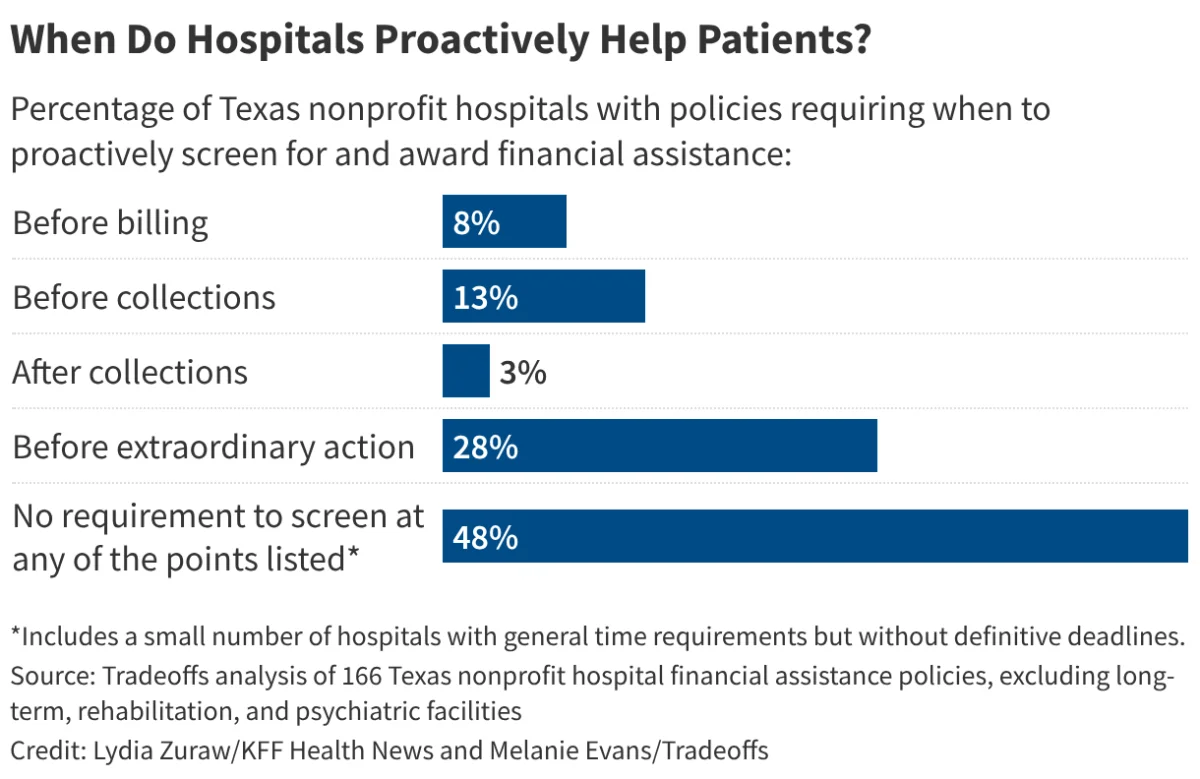
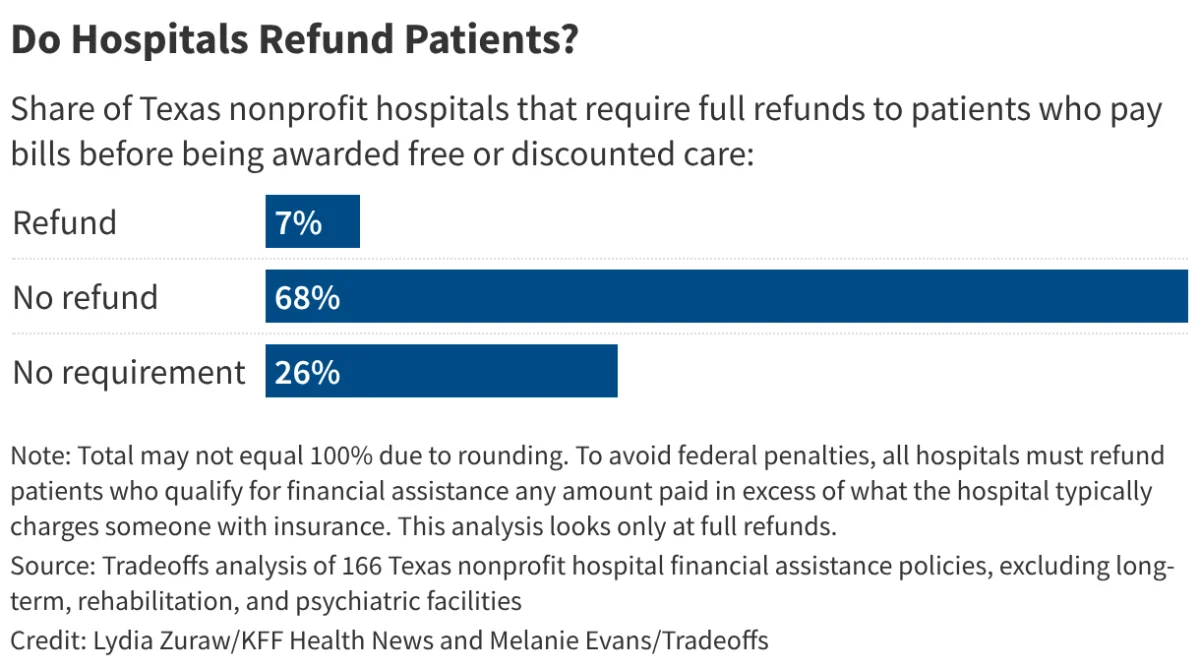
Hospital financial aid can arrive too late to prevent debt. A review of 166 nonprofit general and children’s hospitals in Texas found that nearly half may bill patients before screening them for help, and about two in three have written rules that deny full refunds to some patients later found eligible. The findings point to a gap between having an aid program and making sure patients benefit from it before they pay.
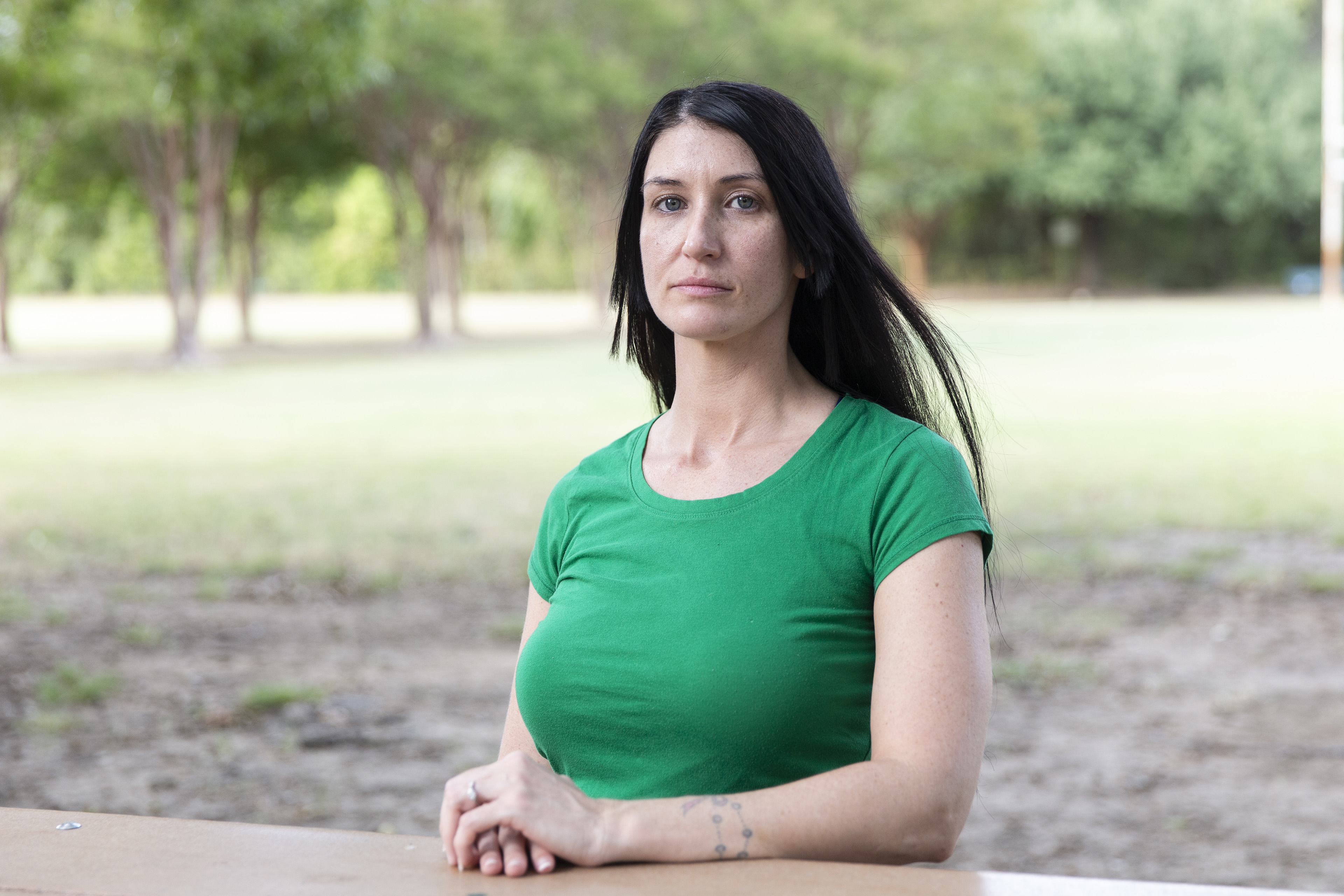
That gap had serious consequences for Aimee Carlock. In August 2025, the 35-year-old self-employed house cleaner needed surgery for severe uterine pain and bleeding. Texas Health Resources told her she needed to pay $5,500 before it would schedule the procedure, she said. She borrowed from her parents and a close friend to cover the cost.
Only after her surgery did Carlock learn that she qualified for financial assistance and that her care should have been free. Texas Health wrote off the rest of her bill, but kept the $5,500 she had paid. Her health has kept her from working much of the year, and she has borrowed for groceries and utility bills. She expects it will take years to pay down what she owes.
Hospitals can use a process called presumptive eligibility to identify patients who are likely to qualify for financial assistance and reduce or erase their bills automatically. The approach can help people who don’t know aid is available or who struggle to complete a lengthy application. Yet hospitals largely decide whether to use it before billing, what information to check, and whether to return money patients have already paid.
Screening is common; early help is less so
Nearly every nonprofit hospital in the Texas review said it can automatically screen patients and reduce bills when they appear eligible. Only about 8% said their written policies require screening before sending a bill. A larger share, 41%, said screening happens before unpaid bills go to debt collectors or the hospital takes other forceful collection steps.
The review gathered hospital policies from state and federal records, a patient aid organization’s listings, hospital websites, direct inquiries, and records requests. The reporters describe it as the first detailed examination of presumptive eligibility practices at nonprofit hospitals. Nationally, about 90% of nonprofit hospitals reported having the ability to grant aid this way in 2022, up from 72% six years earlier, according to a federal data analysis conducted by RTI International for Tradeoffs.
Having a screening system doesn’t mean a patient will be screened in time, or told when a balance has been cleared. Some hospitals told the reporters that staff may screen certain patients before billing even though their written rules don’t require it. Other hospitals place screening later in the process. CommonSpirit Health’s Texas policy, for example, says bills are automatically cleared only after other eligibility and payment sources have been used up.
Covenant Health, a five-hospital system based in Lubbock, was the only Texas system that said it did not automatically grant aid, although its written rules allow the practice. A spokesperson cited administrative and regulatory complexity and said the system helps patients find available assistance.
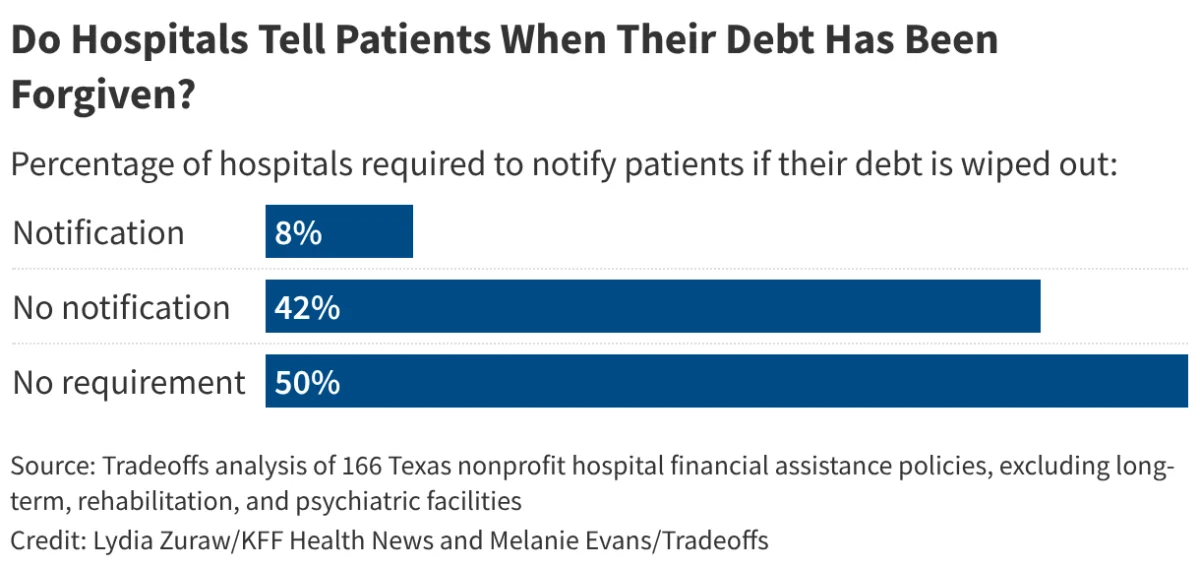
Among hospitals that clear balances after billing, roughly 40% don’t say they will notify patients. Only 8% require notification in their written rules. A patient who doesn’t hear that a bill has been erased may keep setting money aside for it, or may not know that they can use those funds for food, prescriptions, or other needs.
Delay can carry health and financial costs
The timing of aid matters beyond the balance on a hospital statement. Research cited in the review found that people who received financial assistance within weeks of care were more likely to be diagnosed and treated for conditions such as depression and diabetes, and to attend follow-up visits. A separate study found no health benefit among people whose medical debts were erased months or years after the care. Ray Kluender, a Harvard University associate professor who worked on both studies, said the timing of hospital assistance is especially important.
Medical debt can also affect whether people seek care later. A recent study found that people with medical debt were three to four times as likely as those without debt to delay future physical or mental health care. KFF Health News has estimated that 100 million adults in the United States have health care debt, including money owed to hospitals and clinicians, as well as relatives, credit card companies, and banks. Some people respond by taking extra jobs, delaying retirement, or cutting spending on essentials.
Applications can add another hurdle. Patients may be asked for bank statements, pay stubs, car loan details, retirement account information, and divorce records. Neale Mahoney, a Stanford University health economist who studies medical debt, compared the process to a tax audit and said the current approach is broken. Patients may be too sick, overwhelmed, or unaware of the program to navigate it.
Becca Wahl’s experience shows how a bill can change once a patient finds help. The uninsured 33-year-old yoga instructor fainted at a Walmart and was treated for a concussion at Memorial Hermann Katy Hospital. She received a $38,000 emergency room bill. “I just thought you had a bill and you had to pay it,” she said.
The hospital later offered a lower cash price, leaving Wahl with $11,000 to pay and a proposed monthly plan of $1,000, still beyond her means. She found Dollar For online, an organization that helps patients apply for hospital aid. A week after it submitted her application, Memorial Hermann erased the bill. The hospital’s written rules say patients should be screened before a bill is sent. A spokesperson said the system aims to give patients clear information about costs, coverage options, and financial assistance. Wahl said the debt relief lifted a substantial burden.
Hospitals weigh aid against other payment sources
Hospitals and their representatives offer several reasons for placing screening after billing. Anna Stelter, vice president of policy at the Texas Hospital Association, said screening tools can be unreliable and hospitals first need to determine whether a patient has insurance or qualifies for other coverage. She described charity care as a last resort.
Hospitals may also need more information to determine whether someone qualifies for Medicaid or whether another grant can cover the bill. In Texas, the group of adults who qualify for Medicaid is narrow, according to the source. Stelter also argued that writing off bills before insurance pays could shift costs from insurers to hospitals. Patients with insurance often pay a deductible before their plan contributes. Average deductibles are about $2,100 per person for employer coverage and $3,700 for marketplace plans, according to the cited figures. Stelter questioned whether insurers would have reason to lower deductibles if hospitals routinely covered those costs.
Those concerns sit alongside hospitals’ responsibility to provide community benefits. Nonprofit hospitals generally receive exemptions from income, sales, and property taxes in exchange for community support that can include financial aid. Texas has for decades required nonprofit hospitals to meet at least one of several assistance targets, including spending 4% of annual patient revenue on charity care.
Research on spending targets has found mixed effects. Some hospitals increased the assistance they provided; others reduced charity care spending or spent less on other community benefits, such as training doctors and supporting services that lose money but are considered essential. Tom Oliverson, a physician and Texas state representative, argues that hospitals should screen patients before sending bills. The Texas Hospital Association says almost every hospital in the state offers presumptive eligibility, while Stelter cautions that automated tools can make mistakes.
Hospitals may also face greater financial pressure as insurance subsidies are reduced and Medicaid cuts are expected to remove millions of people from coverage. Jill Horwitz, a Northwestern University health policy professor, said hospitals cannot afford to solve the broader problem of people being uninsured or underinsured by paying for all their care. That pressure makes the design of screening programs more consequential: aid rules must help patients while hospitals assess what they can sustain.
Refund rules leave patients with another gap
Carlock’s $5,500 payment illustrates a problem that can arise even when a hospital ultimately grants aid. Roughly two-thirds of Texas nonprofit hospitals have written rules saying patients won’t receive a full refund. Some policies provide no clear promise about returning money after automatic assistance. A CommonSpirit spokesperson said refunds are considered case by case.
Federal requirements generally limit what nonprofit hospitals can charge patients who qualify for financial aid. Some hospitals say they return payments above the amount they would typically charge a person with insurance. But experts told Tradeoffs that the federal refund requirements apply to some patients who submit an application and may not cover patients who receive aid through presumptive eligibility. Texas Health wrote off the remainder of Carlock’s bill but did not return her advance payment. The system did not respond to questions about her case.
Erin Fuse Brown, a Brown University professor who studies medical debt, said patients should be told when a balance is cleared so they can stop budgeting for it. The practical value of that notice is easy to miss: knowing a bill is gone may free up money for food, medicine, or other expenses. Stelter said billing departments often have limited staff and may focus on helping patients apply rather than notifying people whose balances have already been cleared.
Several states are setting screening standards
By July 2027, California, Delaware, Illinois, Maryland, North Carolina, and Oregon are set to require hospitals to use presumptive eligibility for certain patients. Oregon began requiring screening in July 2024 for people who owe more than $500 and for every patient who is uninsured or covered by Medicaid, before the hospital sends a bill. In 2026, the state increased the debt threshold to $1,500 amid concerns about screening accuracy and the financial effect on hospitals.
Tradeoffs’ analysis of available federal hospital data, covering roughly two-thirds of Oregon hospitals, found that average charity care more than doubled during the first full year under the requirement. At OHSU Hospital in Portland, the share of patients receiving financial assistance rose from 12% before the rule to 64%, according to the source. Those findings suggest that earlier screening can substantially expand access to aid, though they don’t by themselves show how the approach affects every hospital or patient.
Oliverson proposed a Texas requirement in 2025 for nonprofit hospitals to screen patients and provide assistance before billing, with penalties for hospitals that fail to do so. The proposal did not pass. He says he plans to bring it back in 2027, with an exception for hospitals that already serve a larger share of low-income patients.
The Texas review’s central finding is practical: an aid program can exist on paper while patients still borrow, pay bills they may not owe, or continue carrying balances after they qualify. Screening before billing, clear notice when aid is granted, and fair refund rules can determine whether financial assistance arrives in time to protect a patient’s finances and their ability to seek care.